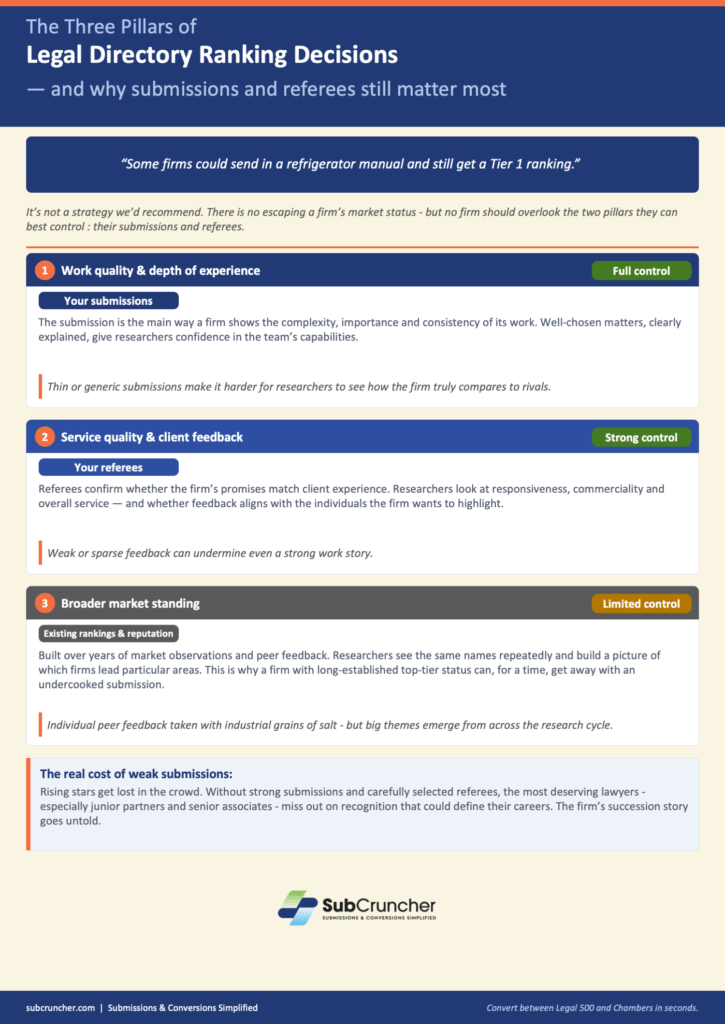
Some law firms could send in a refrigerator manual for a legal directory submission and still get a top‑tier ranking. It’s not a strategy SubCruncher founder, Anthony Notaras, recommends but there is no escaping the power of a firm’s market status
Sometimes a firm simply is the top dog. In those cases, even a dog’s dinner of a Chambers or Legal 500 submission can equal – or occasionally exceed – your perfectly crafted masterpiece. If everyone knows that “Firm X” is the leader in its category, it can maintain a top ranking with a minimal‑effort submission.
But that does not mean this is a safe or sensible long-term approach. 
For most firms, and for most lawyers within those firms, high‑quality legal directory submissions and strong referees remain critical to protecting and improving rankings.
The Three Pillars Behind Legal Directory Rankings
When I was a legal directory researcher, my ranking decisions were dominated by three pillars. Understanding these helps explain why weak submissions sometimes still succeed – and why they are dangerous to rely on.
- Work quality and depth of experience (your submissions)
The first pillar is a firm’s work quality and depth of experience, measured through its submissions. The submission is the main way a firm shows the complexity, importance and consistency of its work in any given category.
Well‑chosen matters, clearly explained, give researchers confidence in the team’s capabilities. Thin or generic submissions make it harder to see how the firm truly compares to rivals, particularly when those rivals have invested time in presenting their best evidence.
- Service quality (your client feedback)
The second pillar is service quality, measured through client feedback. Referees confirm whether the firm’s promises match client experience.
Researchers look at how clients describe responsiveness, commerciality and overall service, and whether that feedback aligns with the individuals the firm wants to highlight. Weak or sparse feedback can undermine even a strong work story.
- Broader market standing
The third pillar is a firm’s broader standing, starting with its existing ranking and supported by years of market observations and peer feedback. Researchers see the same names repeatedly, hear similar views from different sources, and build up a picture of which firms lead particular areas.
Peer feedback can be useful, but I always took it with industrial grains of salt. Some peers are generous, some competitive, and many repeat received wisdom. However, after countless research interviews, a reliable picture does emerge. This is why a firm with long‑established top‑tier status can, for a time, get away with an undercooked submission: its market reputation fills in some of the gaps.
Why Coasting on Reputation Is a Risky Strategy
Absolute market leaders can coast for a while with minimal effort submissions, but they are doing themselves – and their teams – a huge disservice.
Here is why:
- They give ambitious rivals a chance to catch up. When competitors put serious time and energy into their submissions and referees, they can start to rank alongside the market leaders – sometimes when, on a pure quality basis, they probably should not.
- They risk losing control of the narrative. If your submission is thin, out‑of‑date or poorly targeted, you are relying on the researcher’s existing perception of your firm, rather than actively shaping how your practice is understood.
- They leave themselves exposed to one bad year. A couple of weaker matters, key partner moves, or a wave of enthusiastic feedback for a rival can quickly change the balance of perception.
The Real Cost: Rising Stars Get Lost in the Crowd
The greatest damage from lazy submissions often falls on individual lawyers, especially more junior ones.
It is relatively easy for researchers to identify the top firms in a given sector. Those names come up repeatedly in conversations, in feedback and in the legal directories themselves.
Identifying the up‑and‑coming lawyers within those firms is far harder. Without strong submissions and carefully selected referees:
- The most deserving individuals will get lost in the crowd.
- Junior partners and senior associates miss out on recognition that could support their careers.
- The firm’s succession story is never properly told, leaving researchers reliant on old names rather than the next generation.
A thoughtful, disciplined submission process is often the only way to ensure that rising stars are visible and properly understood.
Why Focusing on Submissions and Referees Still Matters
Submissions and referees are the most important ingredients in the rankings process. Even where market reputation is strong, they are the levers a firm can control.
By investing in:
- Clear, targeted submissions that reflect real work quality and depth of experience
- Referee strategies that generate credible, detailed client feedback
firms give themselves – and their lawyers – the best chance of staying visible and being ranked accurately.
Coasting on reputation may work for a handful of obvious market leaders, but only for so long. Their limited visibility with the researchers will compound over time, leaving their next generation of lawyers with a lengthy game of catch up.
Need help with your legal directory submissions?
If you would like support on your upcoming legal directory submissions, SubCruncher offers a wide range of services to support you on your journey – from submission automation through to editorial support. If you would like to find out more, sign up here.
Alternatively, you can email our in-house legal directories expert Anthony Notaras, on Anthony.notaras@subcruncher.com